


Preventing Data Center Downtime: Why PDU Overload Protection Is Your Electrical Backbone
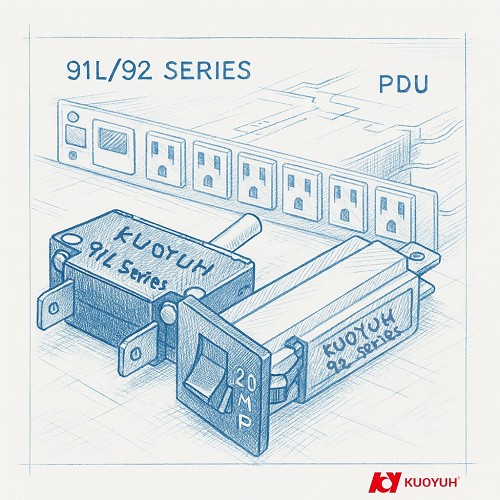
Most server rack failures do not start with the server itself; they start with the power strip.
When a cabinet goes down, engineers usually check the CPUs, hard drives, or switches first. However, the true trigger behind full-rack outages is often simple: PDU overload.
A Power Distribution Unit (PDU) is the electrical backbone of data center stability. If it fails, everything fails. This article explains why proper overload protection is the difference between a minor alert and a catastrophic shutdown.
Why PDUs Become the Hidden Risk?
Many people think a PDU is just a simple socket. But in a data center, it handles massive amounts of electricity 24/7. If the protection is weak, the results are dangerous.
Here is the chain reaction caused by common power issues:
| What Goes Wrong (Trigger) | The Nightmare Result (Impact) |
| Too much power for too long | Wires get hot, plugs melt, and plastic parts deform. |
| Sudden surge (Turning on equipment) | The PDU shuts down instantly, killing power to the whole rack. |
| High Rack Temperature (40–60°C) | Old-school Fuses: Get "tired" and blow for no reason (False Alarm). Result: You have to replace fuses frequently. |
| One device fails (Short Circuit) | Without branch isolation, everything fails. Your NAS, Router, and Servers die at the same time. |
Key Takeaway:
No proper overload protection doesn't just mean "risk" — it guarantees a failure will happen eventually.
What a PDU Really Is (It’s Not Just a Power Strip)
A PDU is not an "extension bar" you buy at a supermarket. It is a critical machine designed to manage power flow.
| Feature | Ordinary Power Strip | Professional PDU (The Backbone) |
| Main Job | Just gives you more outlets | Distributes & Protects: Safely splits power from UPS to servers |
| Overload Protection | Often none, or a cheap fuse | Stops Fires: Prevents the internal copper bars from cooking during a fault |
| When it fails | You throw it away | Remote Management: Allows rebooting specific outlets without touching them |
| Goal | Convenience | Uptime: Ensures the system runs 24/7 without stopping |
True uptime depends on protection and recovery speed, not just wattage.
The Problem with Old-School Fuses
In the past, engineers used fuses. A fuse is a wire that melts to stop power. In modern data centers, fuses are a bad idea for two reasons:
- Downtime is Too Long: When a fuse blows, you have to find a new one and replace it physically. This takes too much time.
- Heat Fatigue: Data centers are hot (often 40–60°C). Heat makes fuses weak. They might blow even when the power is safe, causing "false alarms."
The Solution: KUOYUH Resettable Circuit Breakers
The best way to protect a PDU is to use Thermal Circuit Breakers. They do not need replacement—you just reset them.
KUOYUH offers two specific series designed for PDU systems:
A.KUOYUH 92 Series:
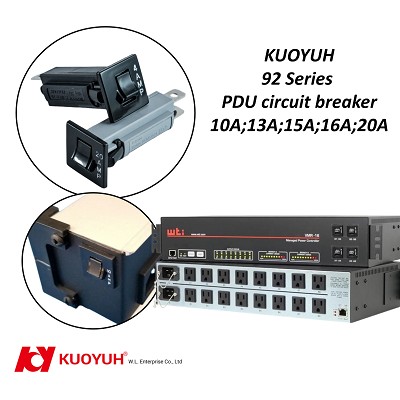
This breaker is designed to sit on the front of the PDU for easy access.
- • Push-to-Reset: If it trips, you simply push the button. Power comes back instantly. No spare parts needed.
- • Trip-Free Safety: Even if you hold the button down, the breaker will still cut power if there is a fault. This prevents accidents.
- • Compact Design: It fits perfectly in 1U or 2U racks where space is limited.
B.KUOYUH 91L Series:
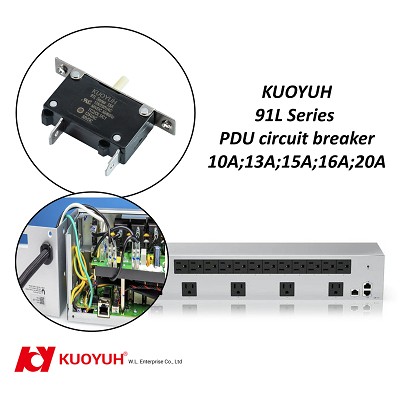
This breaker is usually installed inside the PDU or at the main power input.
- • High Power Handling: Rated up to 20A to protect the main power line.
- • Space Saving: Its small size allows PDU designers to arrange wires easily inside the case.
- • Global Safety: Certified by UL, TUV, and CCC, making it safe for use worldwide.
Technical Snapshot: Why Specs Matter
For those who love details, here is why KUOYUH breakers are built like tanks:
- • Explosion Proof (1,000A Interrupt Capacity): Even if a massive 1,000A surge hits (like a major short circuit), the 91L series will disconnect safely without catching fire.
- • Fire-Resistant Material (Bakelite Body): Unlike cheap plastic that drips when hot, our breakers use Bakelite, which withstands extreme heat and passes the strict Glow-Wire Test.
- • AC/DC Versatility: Designed for modern infrastructure, they support both standard AC power (125/250V) and Telecom DC power (32/50V).
Versatile Applications: Beyond the Data Center
Because KUOYUH breakers are compact and can handle heat, they are not limited to just data centers. Engineering teams around the world use the 92 and 91L Series in other critical missions:
- • Telecom & 5G: Protecting power rails in communication base stations.
- • Industrial & HVAC: Used in heating systems and small transformers where safety is non-negotiable.
- • Commercial Power: The standard choice for high-end UPS systems and professional power strips.
Why this matters: If these breakers are tough enough for industrial factories and 5G towers, you can trust them to protect your sensitive server rack.
How to Select: 92 Series vs. 91L Series
How do you choose the right one? It depends on where you want to put it.
- • For Main Input:Use KUOYUH 91L (2.5A–20A). It protects the whole rack from the inside.
- • For Individual Outlets: Use KUOYUH 92 (0.5A–20A). It goes on the front panel so users can reset it quickly.
- • For High-Heat Cabinets: Both series use Thermal Compensation. This means they work correctly even in hot environments and won't trip by mistake.
Top 5 Real-World Data Center Questions (FAQs)
Q1: Why shouldn't we use fuses in a Data Center?
A: Fuses have two big problems. First, they are "one-time use." If a fuse blows, your equipment stays offline until you replace it. Second, fuses get weak in hot environments, causing "false alarms." A circuit breaker solves both problems because it is resettable and stable.
Q2: My server rack already has a UPS. Do I still need PDU breakers?
A: Yes. A UPS acts like a big battery backup for the source of power. However, it does not protect the wires inside the rack from overheating. The PDU breaker acts as a local guard to stop specific faults immediately.
Q3: Can we use standard circuit breakers (MCB) instead of thermal protectors?
A: Standard MCBs are usually too big. PDUs are very thin (1U or 2U size) to save space for servers. MCBs are too bulky to fit. KUOYUH thermal protectors offer the same safety but are small enough for high-density racks.
Q4: How long does it take to recover power after a KUOYUH 92 breaker trips?
A: It is almost instant. Instead of spending 30 minutes finding a spare fuse, you simply push the reset button. Power is restored in seconds.
Q5: Will the high heat in a server rack cause the breaker to trip by mistake?
A: No. KUOYUH breakers use "thermal compensation." They are built to work correctly even in hot cabinets (45–60°C). They can tell the difference between a hot room and a dangerous electrical overload.
Conclusion
High-density PDUs require protection that is Resettable, Stable in Heat, and Compact.
The core duty of a PDU is not simply power distribution—it is ensuring the power architecture never stops. By choosing the KUOYUH 92 and 91L series, you ensure that a simple electrical fault does not turn into expensive downtime.
Ready to upgrade your PDU design?
Reliable power distribution requires precise components. If you are designing a new PDU system or upgrading an existing facility, ensure your specifications meet modern safety standards. You are welcome to contact the KUOYUH team for detailed technical datasheets and compatibility advice.
Related Reading:
Discover the physics behind the Bimetallic Strip technology, how we solve the Inrush Current challenge, and our rigorous Calibration process in our technical deep dive:
Why do Precision Distributors Need Overload Protection Switches?